
The Experience Matrix: Why Memorable Experiences Drive Engagement, Retention, and Organizational Success
Estimated Reading Time: 6–8 Minutes
Summary: The best events don’t just inform people — they immerse them. This article breaks down the Experience Matrix, a simple framework that explains how different types of experiences drive engagement, retention, and emotional connection. At Momentum Event Management, we use these principles to help organizations create events that people don’t just attend… they remember.
Full Article:
Organizations are no longer competing solely on products, pricing, or even services.
They’re competing on experiences.
From employee engagement and customer loyalty to event attendance and brand perception, the organizations creating meaningful experiences are the ones earning attention, trust, and long-term retention. Research from B. Joseph Pine II and James Gilmore’s groundbreaking concept of the Experience Economy argues that experiences have become the next stage of economic value creation.
But not all experiences are created equal.
Some are immersive. Some are interactive. Some are passive but emotionally powerful. Others are instructional and participatory.
That’s where the Experience Matrix becomes an incredibly valuable framework for organizations, event planners, and experience designers.
At Momentum Event Management, we believe understanding how experiences function helps organizations create events that don’t just “happen”….they create lasting impact.
What Is the Experience Matrix?
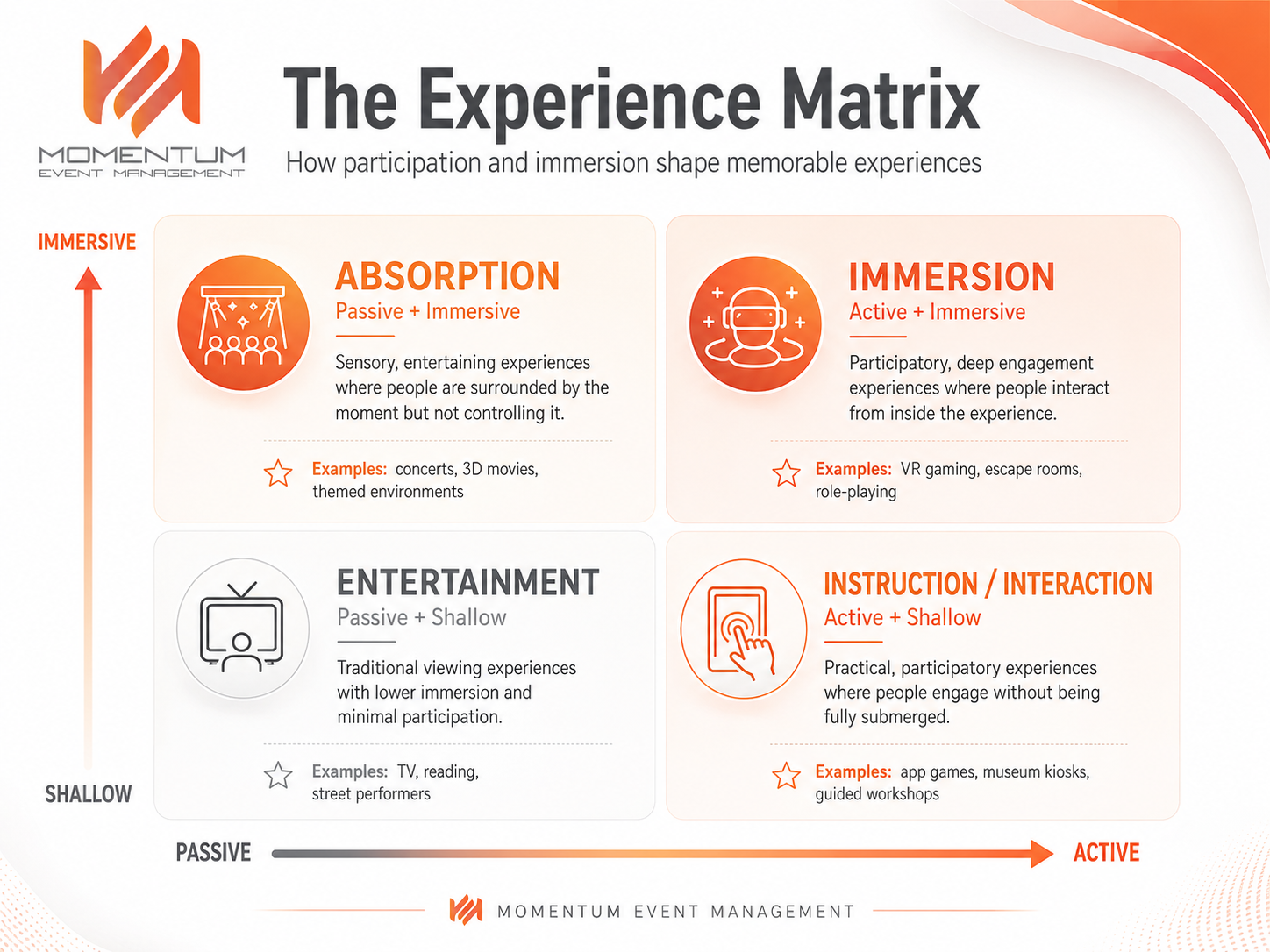
The Experience Matrix is a simple but powerful 2x2 framework used in experience design, entertainment strategy, user experience (UX), and event engagement planning.
The matrix maps experiences along two dimensions:
Passive ↔ Active Participation
Shallow/Sensory ↔ Deep Immersion
These dimensions create four distinct experience quadrants.
Understanding these quadrants helps organizations intentionally design experiences that increase:
Audience engagement
Employee participation
Event memorability
Learning retention
Brand loyalty
Emotional connection
The most successful events and organizations don’t accidentally create impactful experiences.
They design them intentionally.
The 4 Quadrants of Experience
1. Absorption (Passive + Immersive)
“Entertaining” or Sensory Experiences
In this quadrant, people are deeply immersed in the environment or atmosphere, but they are not actively controlling the experience.
They are absorbing it.
Examples include:
Concerts
Cinematic experiences
Immersive stage productions
Projection mapping
Highly themed environments
Keynote presentations with strong storytelling
Brand activations with sensory design
The audience becomes emotionally transported even though they remain primarily observers.
This is one reason organizations invest heavily in production quality, lighting, sound design, scenic environments, and storytelling. Sensory immersion dramatically increases emotional recall and memorability.
Research surrounding the Experience Economy consistently demonstrates that memorable experiences create stronger emotional attachment and differentiation for organizations.
Why It Matters for Organizations
Absorptive experiences are powerful because they:
Create emotional resonance
Build stronger brand perception
Increase audience recall
Enhance storytelling effectiveness
Generate “wow-factor” moments
When organizations neglect sensory design, events become forgettable.
2. Immersion (Active + Immersive)
Participatory and Deep Engagement Experiences
This quadrant represents the highest level of engagement.
People are not just observing the experience.
They are inside it.
Examples include:
Escape rooms
Virtual reality (VR)
Interactive simulations
Team challenges
Gamified activations
Role-playing workshops
Hands-on collaborative environments
Immersive participation creates stronger emotional ownership because attendees become co-creators of the experience.
Studies on immersive collaboration environments have shown that immersive participation can increase interaction, contribution equality, and engagement among participants. Read the study here
This is why interactive corporate experiences are rapidly growing in popularity.
People remember what they actively participate in.
Why It Matters for Organizations
Immersive experiences can:
Increase engagement levels
Improve team collaboration
Strengthen emotional connection
Improve learning retention
Increase participation and energy
Encourage deeper organizational buy-in
This is especially important for:
Corporate retreats
Team-building events
Leadership development
Employee onboarding
Customer activations
Conferences and trade shows
Organizations wanting stronger engagement cannot rely entirely on passive experiences anymore.
3. Entertainment (Passive + Shallow)
Traditional Viewing Experiences
This is the most familiar quadrant.
People observe the experience, but the level of immersion is relatively low.
Examples include:
Watching television
Listening to presentations
Watching a street performer
Viewing informational content
Attending standard meetings
There’s nothing inherently wrong with this quadrant.
In fact, entertainment still plays an important role in communication and engagement.
But organizations often unintentionally stop here.
And that’s where many events lose momentum.
The Organizational Risk
Passive-only experiences often struggle to:
Sustain attention
Create emotional investment
Improve retention
Encourage participation
Differentiate the event
Research in customer and employee experience management continues to show that deeper experiential engagement leads to stronger connection and long-term value creation. McKinsey’s research on employee experience found that employees with positive experiences are significantly more likely to stay engaged and remain with their organizations.
If every event feels like “another presentation,” organizations miss opportunities to create memorable moments.
4. Instruction & Interaction (Active + Shallow)
Practical and Participatory Experiences
In this quadrant, people actively participate, but they are not fully immersed.
Examples include:
Workshops
Guided exercises
Interactive kiosks
Polling activities
Networking sessions
Simple gamification
Breakout discussions
This quadrant is highly valuable because active participation increases learning and involvement.
Even relatively simple interaction can dramatically improve attention and retention.
This is why effective conferences increasingly incorporate:
Audience polling
Collaborative breakout sessions
Interactive technology
Guided networking
Hands-on activities
Why It Matters for Organizations
Interactive experiences help organizations:
Improve knowledge retention
Increase attendee participation
Encourage collaboration
Collect feedback in real time
Improve employee engagement
Create more dynamic events
Sometimes small interaction changes create massive engagement improvements.
Why the Experience Matrix Matters for Event Strategy
The most impactful events intentionally combine all four quadrants.
Think about a modern conference:
Experience ElementExperience QuadrantOpening keynote with dramatic visualsAbsorptionInteractive breakout workshopInstruction/InteractionVR activation boothImmersionNetworking receptionInstruction/InteractionLive entertainmentEntertainment or Absorption
The best event experiences move attendees through multiple forms of engagement.
Why?
Because variety sustains attention and creates emotional momentum.
At Momentum Event Management, this is one of the key strategies behind designing experiences that feel dynamic instead of repetitive.
Experiences Drive Employee Engagement and Retention
Experience design is not just about entertainment.
It directly impacts organizational outcomes.
Research on employee experience and organizational engagement shows that well-designed experiences contribute to:
Higher employee engagement
Improved workplace satisfaction
Stronger emotional connection
Better collaboration
Increased retention
Improved productivity
According to Deloitte’s workforce experience research, organizations that intentionally design employee experiences increase retention, satisfaction, and even customer loyalty.
Meanwhile, Gartner’s employee experience research emphasizes that organizations delivering strong employee experiences outperform competitors in engagement and performance.
Employees want more than information.
They want connection.
They want participation.
They want experiences that feel meaningful.
This is especially true for:
Corporate events
Team retreats
Leadership summits
Training sessions
Company celebrations
Culture-building initiatives
The Future of Events Is Experience-Led
As attention spans shrink and digital overload increases, organizations face a major challenge:
How do you create moments people actually remember?
The answer isn’t simply “more content.”
It’s better experiences.
The organizations that will stand out in the future are the ones that understand:
Engagement is emotional
Participation matters
Immersion increases memorability
Experiences create connection
This is the foundation of the Experience Economy.
And it’s why intentional event design matters more than ever.
How Momentum Event Management Helps Organizations Create Memorable Experiences
At Momentum Event Management, we help organizations move beyond simply hosting events.
We help create experiences that:
Engage attendees
Strengthen organizational culture
Improve participation
Build emotional connection
Increase retention and recall
Leave lasting impact
Whether it’s a conference, retreat, corporate gathering, activation, fundraiser, or leadership event, intentional experience design changes how people feel, engage, and remember.
Because people may forget information.
But they rarely forget how an experience made them feel.
Ready to Create a More Memorable Event?
If your organization wants to create experiences that engage people on a deeper level, Momentum Event Management can help you design events that are intentional, immersive, and impactful.
Book your 30 minute discovery call today, and begin building your experience with us.